
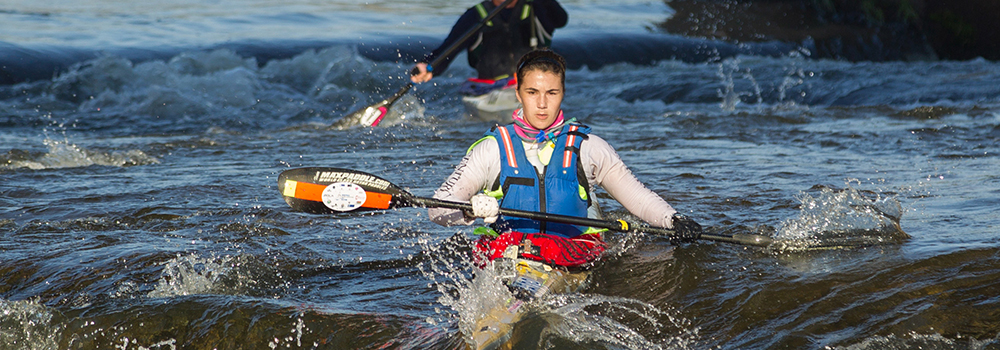
The race for the women’s title at the 2021 Berg River Canoe Marathon will provide a captivating spectacle for the 60th anniversary of the famous four-day race from Paarl to Velddrif that starts on Thursday morning, with arguably the strongest women’s field ever assembled in the race’s history.
West Coast local Bianca Beavitt is relishing the return of the individual Berg competition format after two years in the two-paddler team format, and will start as one of the strong contenders to secure what will be a fourth Berg title.
She will square up against a women’s seeded batch bursting at the seams with talent, and simply making the women’s podium this year will be a notable achievement.
MyLife Dusi singles runner-up Jordan Peek will be making her Berg debut and if she can use her endurance ability and tenacity to counter her lack of experience on the river, a victory on her maiden Berg will be the race’s major talking point.
She comes to the Western Cape classic through the new Kindo-backed reciprocity arrangement that will see the Dusi men’s and women’s stars invited to race the Berg each year.
Tracey Oellerman returns to the race as the defending champion, having won the women’s team competition with Melissa van Rooyen in 2019, and the Stellenbosch-based student will be eager to return to the Berg podium.
Nikki Birkett, the wife of former Berg champ Andy Birkett, also lines up at the front of the women’s batch and poses a serious threat to the women’s title.
During the extended lockdown she has been central to the East London training squad with her husband, and her form suggest that she has done the necessary mileage and has the attacking speed to justify her status as one of the favourites.
A few weeks ago she shook the tough Scottburgh to Brighton surfski marathon by winning the women’s title going away, finishing comfortably in the top twenty overall, hinting that her base building towards the 240km-long Berg is impressive.
Add to the women’s mix form athletes like Shannon Parker-Dennison and Tash Bradford, and there will be little margin for error for the elite women hoping for a podium finish at this landmark edition of the race.
It will be fascinating to watch the progress of Danish ultra-marathon paddler Susan Lützner on her debut Berg. The jet-setting Dane arrives in the Cape just hours before the race, but comes off a massive northern hemisphere summer that has seen her do well in a number of long distances, including the Sorø Kajak Marathon last month, followed by the Amager Rundt marathon and the Lolland marathon.
She already has a Dusi and Drak under her belt, and once she masters the trees and other unique challenges of the Berg, her ultra-distance pedigree will stand her in good stead.
Lisa Scott will be out to secure a unique record in the women’s race when she sets off for what will be a record thirteen Berg medal, bettering the mark of twelve that she currently shares with Jean Wilson and Helen Boehm.
Behind her, expect to find plenty of support for local master paddler Flo Els, who after a staggering performance on the virtual Ultra Paddle, has been given a place on the actual Berg start line.
As the race reflects on its six decades of history, it is perhaps apt that the women’s race enjoys much of the attention. When the pioneers paddled the first Berg in 1962 women were not allowed to take part and for the next decade their involvement was limited to paddling the final stage into the West Coast town of Velddrif.
Teenager Cheronne Botes won the first women’s Berg title in 1978 marking a milestones for the race’s sixteenth edition. Marinda Hartzenberg went on to dominate the women’s race in the eighties with her record of seven successive Berg titles. Jean Wilson, Antje Manfroni, Alex Cole, Abbey Ulansky and more recently Bianca Beavitt have all proven to be the Berg women’s race pacesetters since then.